Procurement Solutions - @ Power of Internet

Showing posts with label India. Show all posts

Wednesday, 3 June 2015

Yummy Mangoes!

When I was a kid, I used to wait for summers only for two reasons – Long Summer Vacation and Yummy Juicy Mangoes.

Mango, King of Fruits and National fruit of India, is known for its luscious taste.

Apart from their delicious taste, mangoes are also known for their cultural values and importance. Mango leaves are used to decorate doors in Indian houses during festivals. Dried Mango skins are used to produce Ayurvedic medicines.

Mango is also known for its usage in countless number of cuisines. Sour and unripe mangoes are used in Pickles. Mango pulp is used for making jellies and jams. Dried and powdered unripe mango is used for moramba, amchur. Liquid form of mango, example - Aam panna, Aamras, Mango Lassi etc., is also equally famous for its taste and nutritional values.

India is home to more than 500 varieties of Mangoes. Let’s learn about a few famous sub-categories, where to get and how to use them.
Alphonso Mango


  • One of the most expensive, yet beloved, variety of Mango in India and abroad.
  • This variety grows in Maharashtra, Gujarat and Karnataka.
  • Used mainly for pulping and canning.
  • Its firm yet fibreless pulp ensures a smooth creamy taste while still maintaining its integrity when cut.

Chaunsa Mango

  • Its name was given by Sher Shah Suri, as this was his favourite, it’s hailed as “The King of Mangoes.”
  • This variety grows in North India, starting from early June through the end of August.

Dasheri Mango


  • Dashehari mangoes are one of the “Mother” mango varieties in the country.
  • Mainly cultivated in Northern India. Lucknavi (Lucknow based) Dashehari is famous across the globe.
  • Fruits are medium sized, with pleasant flavour, sweet, firm and fibreless pulp.

Banganapalli Mango


  • This mango is Andhra Pradesh’s prime variety. Also available in Tamil Nadu.
  • Mainly used for canning.
  • Its fruits are large sized, weighing on an average 350-400 g, with fibreless pulp.

Langda Mango

  • Langda mangoes are primarily native of Varanasi, UP.
  • The fruit is green on the outside, which might give you the impression that it’s not ripe. But you can’t be more wrong.
  • It has a short season, lasting from mid to the end of July.
  • It has a very distinctive taste and not over sweet.

Himsagar Mango

  • This variety grows in West Bengal and Orissa.
  • Himsagars come to season from mid-June until the end of the month.
  • It’s a thin-skinned cultivar with smooth, silky flesh.

Kesar Mango

  • It comes from Gujrat.
  • Yellow with a tinge of green on the outside, Kesar mango is famous for its subtle taste.
  • Ideal for pulping and juice concentrates.

Neelam Mango
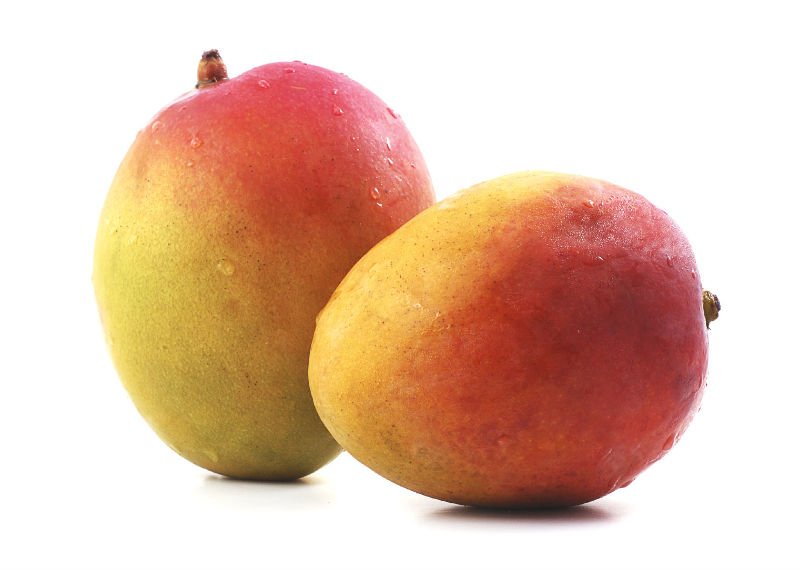
  • South India, Hyderabad in particular, is famous for this variety.
  • Neelams come to the markets in May and last until the end of June.
  • Fruits are medium sized with soft, yellow and fibreless flesh.

Totapuri Mango

  • Its small green appearance and beak at the end of the fruit resembles a parrot, hence its name.
  • It’s acceptable to eat the skin of this variety.
  • This variety is a bit crunchy and tangy, best served with salt and chili powder.

Mallika Mango

  • Hybrid of the Neelam and Dasheri mangoes.
  • Its orange pulp is of excellent quality thanks to its pleasant honey sweetness.
  • Proud winner of the Fairchild Tropical Garden Best of Show award for taste.
  • Mallika’s season lasts from June to July.

If I talk numbers, India is the largest producer of Mangoes with almost 36% of the world’s production. But let’s not let numbers spoil the divine taste.

Personally, I am yet to find a person who doesn’t like mangoes. Even though high in calories, mangoes are worth your craving.

Come on friend, Go and Grab one now!!! Happy Eating. 

Tuesday, 26 May 2015

Kitchen of India - Exotic Spices

One thing which is common among us Indians is: Our Love for Food!

Each and every state has its own set of cuisines and flavors. And as we all know: Best way to understand a place is through its culinary culture.

Be it spicy Biryani from Hyderabad, Daal-Baati Churma from Rajasthan, Macher Jhol from West-Bengal or amazing Kashmiri Pulao, each and every cuisine is unique in its aroma and taste. Each of our states has a unique culinary story to tell.

But if we dig deeper, there is one thing which makes these cuisines delectable – its Ingredients. 

“The Kitchen of India” has ample number of rare ingredients which are cherished by Chefs, all over the world.

Let’s take a step further and get on a journey to explore different varieties of ingredients commonly found in India.

In our quest of better understanding a typical Indian Kitchen, the first and most important set of ingredients which comes to my mind is – Exotic Spices of India.

Let’s learn where to find and how to use them in detail:

Saffron
    • Saffron is the most expensive spice in the world.
    • Fortunately, only a small amount of it is required to impart its beautiful color and flavor to food.
    • It is used in many Spanish and Indian cuisines, mainly Seafood Paella, Biryani etc.
        Black Cardamom or Badi Elaichi
    • Also known as Queen of Spices.
    • Its seed pods have a strong camphor-like flavour.
    • It is commonly used in many Indian, Nepalese, Bhutanese and Chinese dishes.
Red Chilli Powder
    • Also known as King of Spices.
    • It is used to add pungency and flavour to dishes.
    • It is used in many different cuisines, including Tex-Mex, Indian, Chinese, and Korean.
Amchoor

    • It is a fruity spice-powder made from dried, unripe green mangoes.
    • Commonly used as a souring agent in Indian cuisines.
Carom seeds or Ajwain
    • Mainly produced in Rajasthan in India, Ajwain has many health benefits as well.
    • Primarily, it helps in digestion and cough & asthma.
    • Commonly used in cuisines in India and Afghanistan.
Long Pepper
    • It is mainly used in European, Indian, Nepalese, Indonesian, Malaysian and North African cuisines.
    • It has similar, but stronger taste than black, green or white varieties of pepper.
Nigella seeds or Kalonji
    • It has a pungent - bitter taste and smell.
    • It is used primarily in confectioneries and liquors. Peshawari naan is topped with kalonji seeds.
Cumin seeds or Jeera
    • Cumin can be used ground or as a whole seeds.
    • It helps to add an earthy and warming feeling to food.
    • Mainly used in South Asian, Brazillian and Latin American cuisines.
Asafoetida or Hing
    • It typically works as a flavour enhancer.
    • This spice is a digestive aid and is used in food and pickle as a condiment.
Cinnamon or Dalachini
    • Mainly is used in preparation of Chocolate and dessert recipes.
    • Cinnamon flavored tea, is consumed as a hot beverage in Bangladesh, India and Pakistan.
Being an Hotelier in India, it’s our duty to learn about these ingredients, experiment with them and add them to our recipes.

Let’s take our guests to a culinary journey and let them rediscover the meaning of Indian food. Let’s make them fall in love with Indian Kitchen all over again.

Stay tuned for next article in this series – Exotic Fruits and Vegetables in India.

Till then – Bon Appetite!!!

Tuesday, 19 May 2015

What Supplies Guests are actually looking forward to in a Hotel Room?

Being a passionate traveler, I have been lucky to experience hospitality from many hotels across India. In hotels, apart from well-mannered staff and good hygiene levels, one thing that I look forward to is ‘Guest Supplies’. Generally, these amenities are crucial to give guests 'home away from home' feeling.

Liking and preferences of different guests vary. And these can vary for things as minute as degree of softness of pillows to fragrance of flowers!!

In hospitality industry, the aim of the service provider is to delight and pamper its customers. I personally believe that standard of a hotel is defined by the kind of services and facilities it offers to its customers.

For a procurement manager, satisfying its guests is like doing a rope walk between managing budget and fulfilling guests’ wimps.

So, it would really help if someone can decode the mystery of ‘What Supplies Guests are actually Looking Forward to’ in priority order.

But before answering this question, it’s important to segment consumers. For simplicity, let’s segment them into: Budget Guests and Premium Guests.
Expectations of these two kind of guests can be poles apart.

Let’s try to look at these expectations in finer detail:
  • Budget Guests
    • These are your value-centric guests. They expect you to provide good quality services at an affordable price.
    • In this case, hoteliers are advised to focus on their basic needs. This group of guests might get satisfied with things like timely room service, water bottles in the room, clean bed-sheets and so on.
  • Premium Guests
    • These guests are quality-centric. They expect you to take care of all there comforts, irrespective of costs involved.
    • In such a case, hotels need to add a “wow factor” in their services. For example, a bottle of wine or a basket of exotic fruits can seal the deal.

Now that we have gathered a basic understanding of expectations of different guests, let’s generalize it into a holistic concept and answer our key question ‘What Supplies Guests are actually looking forward to in a Room?’

To answer this, I will take reference from the best theory available on needs and wants, i.e. Maslow’s Hierarchy of Needs.
  • Physiological Needs:
    • These are basic needs which any guest (be it budget or premium guests) will expect from any hotel room.
    • Example: Water bottles, bed, bed sheets & pillow cases etc.
  • Need for Security:
    • As for this need, guests look forward to personal security in their rooms.
    • Example: Door locks, Hygienic toiletries, Privacy in room etc.
  • Needs for Belonging:
    • As per this need, hoteliers should be able to convince guests that they are being taken care of.
    • Example: Well-mannered & friendly 24X7 Room service, Doctor-On-Call & other on call services etc.
  • Esteem Needs:
    • After all who doesn't like being respected? To showcase their gratitude & respect, hoteliers can give a personal touch to rooms.
    • Example: Exotic Fruits & flowers basket, Bottle of wine etc.
  • Self-Actualization Needs:
    • This is the most difficult stage to fulfill. To attain self-actualization, hotels will need to comfort guests in all possible manner- rooms, events – everything should be designed according to guests’ choice.
    • Example: Artistically designed rooms, specially designed itineraries & events.


While budget guests might get happy by merely first three steps, a premium guest will need to be taken through complete ‘Maslow’s Hierarchy of Needs’ to be satisfied.

To summarize, I would like to say:
First step starts with understanding your hotel’s target segment and consumer mind set (Budget or Premium). 
Second step will be to classify various services based on Maslow’s Hierarchy of Needs.
These two steps will help you in devising a sound strategy. After all this, final step is to procure items at the best possible rate and full-fill your guests' desires.

Hoteliers, now that you know the answer to one of the most difficult question in Hospitality, I wish you all the very best for procurement.


Keep your Guests Happy!

Wednesday, 13 May 2015

5 Avenues to find best Hospitality Professionals

Hospitality Industry is largely service centric. The quality of services a hotel provides to its guests can make or break its reputation.

If we talk about numbers, Hospitality contributes 12.4% to the country’s employment chart. As per the Ministry of External Affairs, Indian hospitality sector is growing at the rate of 14% aggregated annually. As the industry grows, so does the need for talent.

And when one talks about best Hospitality talent – first country that comes to my mind is - INDIA.

Hospitality is imbibed in us Indians since our childhood. Even our culture says “atithi devo bhav” (guest is god).

Still, finding the best talent, fitting ones exact needs can be a tricky affair.

Hotels across the world are making use of state of the art technologies to attract right talent.

Let’s look at some of the avenues you can use to attract best talent:
  • Social Networks
    • Be it attracting customers or attracting employees, you can’t overlook the power of social media.
    • Many HR managers across the world have made LinkedIn a permanent tool in their arsenals. Even Facebook is often used to find good talent on a short notice.
    •  As for employees, they can benefit from portals like Glass-Door to get a good idea of work culture in company of their choice.
  • Campus Interviews
    • When ‘Catch them early” is the call.
    • Advantage with this is that you can get some really bright students full of vigor and determination at fairly decent salaries.
    • Training of the resources is a huge responsibility in such cases. Not to forget time and money involved in visiting campuses.
  • Career Expo
    • Career expo or job fair is yet another hunting place for recruiters.
    • This is an age old, tried and tested avenue. Job seekers from every nook and cranny come to such expos. Easily, career expos are the best place to gather primary data on job market and to personally meet potential recruits.
  • Human Resource Management Systems
    • These include some of the most hi-tech and widely used systems and software.
    • Taleo, Oracle, Kenexa from IBM, Lumesse include some of these. They take care of most of your recruitment needs and make data available at one spot. 
    • Well-known firms like eQuest, Broadbean etc. sell high-quality data-analytic tools to boost the recruitment process.
  • Online Portals
    • Portals like naukri, monster etc. have become an inclusive part of almost every company.
    • This is a common step almost every recruiter takes while selecting candidates.

A good HR personnel makes use of a mix of above mentioned alternatives to come up with an effective recruitment strategy.


I wish everyone a good and successful recruitment process.
Happy Talent Search!

Wednesday, 15 April 2015

Future of Hospitality Industry in India

As per latest reports, India can overtake China in 2015 to become the world’s fastest growing major economy and can widen the gap further in 2016 (refer to the link for complete details.)
Today India is at a position where the whole world is keeping an eye on her every step. And trust me friend, India is taking each and every stride in her growth with flair. When one talks about flair, first thing that comes to my mind is Indian hospitality.
If I talk about numbers, hospitality backs 6.23 % to country’s GDP and 12.4% to the total employment. 
But mere numbers can’t capture the grandness and scale of this beautiful industry. From the iconic Taj Mahal Palace to the grandeur of Leela Palace Udaipur, India has gems of hotels whose shine attracts guests from across the world.
But all this is just what the present has to offer. Only one can guess what secrets future has in store.
Let’s look at key influencers to the growth of Indian hospitality:
Globalization: 
The “world is flat” like Mr.Thomas L.Friedman describes in his famous book.
Humans are getting more wander some than migratory birds !!
This calls for the need of supercilious quality of service, customized to the needs of new age travelers. Who knows, maybe one day you will be able to book a 5 star for few hours based on your visiting needs.
At the same time, Indian professionals are making their roar heard across the length and breadth of the world. No matter where Indian travelers go, they remain Indian at heart. We command our Khakra and Jalebi sitting on Mt. Rushmore, and the world obliges.
Government Initiates: 
The Indian government realizes the potential Hospitality has in store.
Dr. Mahesh Sharma, the Minister of State of Tourism, Culture and Civil Aviation, has taken up charge of improving cleanliness and safety levels of India Tourism.
Government has come up with “Electronic Travel Authorization (ETA)” scheme that will aim at raising Hospitality to new heights.
Adding cherry to the cake, FDI will put growth of hospitality in India on an expressway.
New avenues of growth: 
Any industry in the world rests on a simple game of demand and supply. If the demand rises, so does supply and thus growth.
With the increase in disposable income and middle class gaining strength, hospitality seems ever so promising.
Moreover, Indians have distinguished demands and tastes, and when we go abroad, it reflects in the services we ask for.
Hotels will have to keep abreast of these demands and make provisions to add “wow factor” in their services.
This will be general rule for all kinds of hotels, be it an airport hotel, business class hotel or a general lodge/ timeshare hotel.
Innovative Operation-Models:
Change is the only permanent today.
 As the industry grows, there will be need for more innovative operation-models to accommodate industry wide  changes.
There are some practices happening today, that guarantee better operation-models tomorrow. Some of these practices include:
  • Plan – Do – Check
    • It is an age old model with proven results. However, planning each move before-hand comes with experience.
  • Understanding Customer
    • As customer is the one who will be finally making use of your services, it is best to understand his / her needs before designing any service. As such, hotels across the world are investing heavily to better understand changing needs of global guests
  • All Inclusive growth model
    • An all inclusive growth model will benefit everyone. As such, hotels are making conscious efforts to keep their employees motivated. A happy employee ensures hotel can adapt to the changing needs of guests
Overall, future of Hospitality looks as bright as pole star in night. 
Let’s enjoy this journey to the fullest!